Drogmi Buddhist Institute

The Wisdom Age Blog

News from Drogmi Buddhist Institute
The Wisdom Age Blog includes articles from The Wisdom Age newsletter
  • Home
  • About DBI
    • History of Drogmi Buddhist Institute
    • Khenpo Ngawang Dhamchoe
    • Photo gallery
    • Contact
  • About Sakya
    • The Sakya lineage
    • The five Sakya founders
    • Sakya Masters
    • Throneholders of Sakya
    • Lam Dre
  • Courses & events
  • Resources
    • Past teachings
    • Meditation guides
    • Prayers
    • Shrine room etiquette
    • Dharma links and resources
    • Request for Prayers
  • Support us
  • Wisdom Age
  • Retreat Hut / Venue hire

14/4/2024

Rongton Buddhist Centre, Queensland, 2024

Read Now
 

VISIT BY KHENPO NGAWANG DHAMCHOE
​13-14 April 2024

Picture
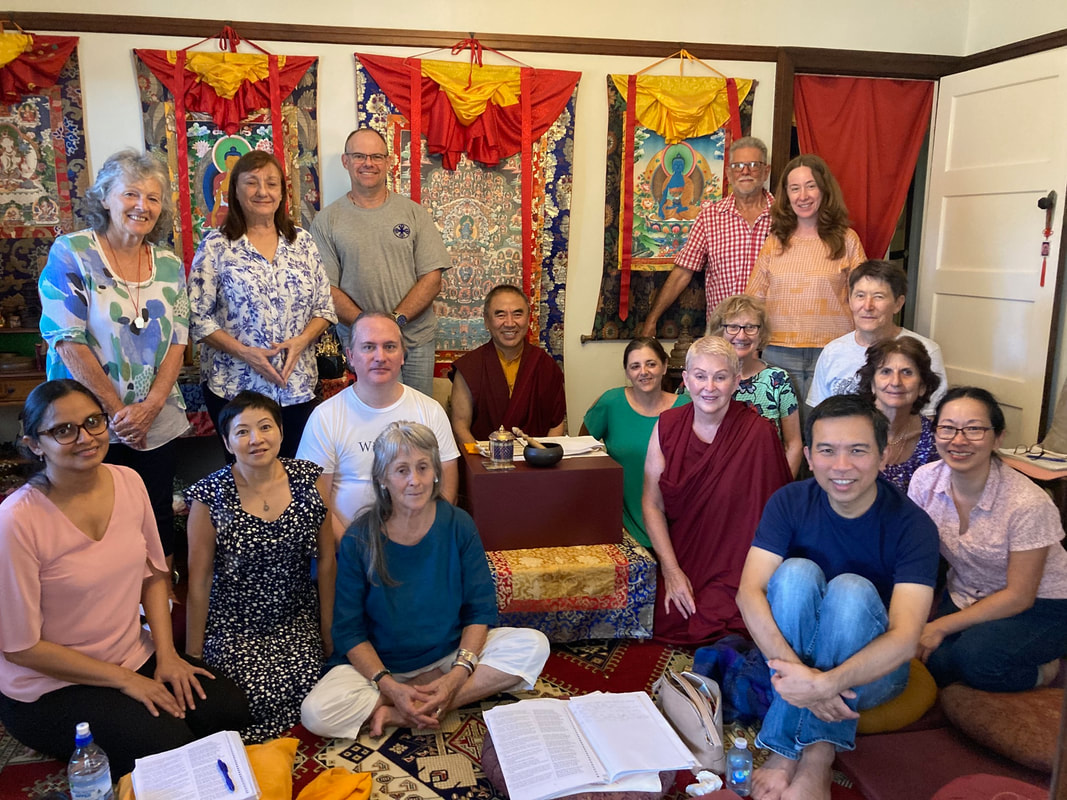
Khenpo la’s visit to Rongton Buddhist Centre this year was a greatly anticipated and joyful occasion, with all members of the sangha relishing face to face connection with one another here in Brisbane.

The teaching program in 2024 consisted of two topics: an introductory one-day teaching on The Fundamental Verses of the Middle Way (Prajna Nama Mulamadhyamakakarika), followed by a one-day teaching on the 21 Taras.

The Mulamadhyamakakarika is part of the Perfection of Wisdom teachings according to the common history of the Three Turnings of the Wheel by Shakyamuni Buddha. It is a Mahayana text composed out of great compassion by Nagarjuna, illuminating the Middle Way, free from the extremes of nihilism and eternalism.

Khenpo la explained that the Buddha gave many teachings, but with only one purpose: for sentient beings to become free from our ignorance mind. Individual mind comes from individual perception, which constitutes conventional reality – that is, the way that each of us thinks. However, absolute reality or truth is of one flavour, and is far more profound than conventional truth.

As Dharma practitioners, we need to first understand interdependent origination in order to overcome nihilism, which will then help us to understand and realise ultimate truth. Clinging to our ordinary perceptions of who we think we are, needs to be remedied by re-identifying ourselves, and this is achieved by studying teachings on the clarity of the mind (conventional truth) as well as by studying teachings on the emptiness of the mind (absolute truth). When we realise the union of these two, we realise no-self, which is nirvana. As Khenpo la said, wisdom mind will never deceive you, and therefore we need to work with our mind to see and understand reality correctly. 

Candrakirti (a disciple of Nagarjuna’s) taught that we should accept conventional reality, otherwise it’s confusing; however, when mind is caught up in negativities, we then need to investigate the mind and find out whether conventional reality is valid in an ultimate sense, in order to free ourselves from attachment and aversion. If we’re really caught up with something, it is best at that time to remember emptiness, and then we won’t blame something or someone for a situation that we find ourselves in. 

Khenpo la then outlined the eight conceptualisations that keep ordinary beings in samsara: the concepts of going and coming, cessation and arising, nihilism and eternalism, and separation and one (or oneness). The main topic of Nagarjuna’s text therefore deals with the refutation of phenomena arising. So, for example, when something appears (e.g., a rice plant), if this truly exists separate from our mind, there are only four possibilities as to how it arises: from self, from other, from both self and other, and from neither self nor other.

The text then goes on to explain the philosophical views of different schools in relation to the above, and then shows from a logical point of view, that these four possibilities can all be refuted. As it’s beyond the scope of this article to go into any more depth here, and as it’s also beyond my own understanding to elaborate much further on Khenpo la’s teaching, I will now briefly outline his teaching on the 21 Taras.

Sunday’s session began with Khenpo la giving a transmission of the 21 Praises to Tara, in order to connect our mindstream to the blessed lineage of Tara. Khenpo la then gave three brief historical accounts of Tara, including how she came to be an enlightened Buddha many aeons before Buddha Shakyamuni. He also explained how in Vajrayana there are four main classes of tantra (Kriya, Charya, Yoga, and Anuttarayoga), and while Tara practice can be done at all four levels, it is usually practised at the Kriya level. In Kriya, the emphasis is on cleanliness and diet (practice is most effective when one is vegetarian); the practice can be done at any time of the day, and it’s important to have a consecrated image of Tara.

Following transmission of the Tara mantra, Khenpo la went through each of the verses of the Praises to 21 Taras (composed by Buddha Vairocana), explaining that her 21 primary emanations perform different activities, of which there are four main types: pacifying, increasing, overpowering/magnetising, and wrathful. Each of these four activities are symbolised by the colours of white, yellow, red and black, respectively. They all come from Green Tara, as green is the colour of the Buddha’s enlightened activities (symbolised by Amoghasiddhi). 

Tara is often referred to as the mother of all the Buddhas as she embodies wisdom and all enlightened activities; praying to Tara is the same as praying to all the Buddhas. Just as a mother who hears her child crying, drops everything immediately to rescue her child, so too when we call on Tara, she swiftly appears like lightning, in order to help suffering sentient beings. The Sanskrit name “Tara” therefore means Protectress or Saviour. In the Mantrayana tradition, one needs countless skills to help sentient beings due to their different dispositions and levels of intelligence, hence the need for Tara’s different emanations and activities as described above.
​
On behalf of Rongton Buddhist Centre, I would like to thank Khenpo la for his great kindness in teaching these topics, and for the meticulous detail he gave for each. By dedicating the merits of these teachings, may all beings be blessed by realising the ultimate truth of existence! 
~ Robin M

Share


Comments are closed.
Details

    Categories

    All
    Issue 44
    Issue 45
    Issue 46
    Issue 47
    Issue 48
    Issue 49
    Issue 50
    Issue 51
    Issue 52
    Issue 53
    Issue 54
    Issue 55
    Issue 56
    Issue 57
    Issue 58
    Issue 59
    Issue 60
    Issue 61
    Issue 62
    Issue 63
    Issue 64
    Issue 65
    Issue 66
    Issue 67
    Issue 68
    Issue 69
    Issue 70
    Issue 71
    Issue 72
    Issue 73
    Issue 74
    Issue 76
    Issue 77
    Issue 78
    Issue 79

    View previous newsletters here.
Vertical Divider
Home
 
About DBI
 
About Sakya
 
Courses & Events
 
Resources
 
Support Us
 
Venue Hire
 
Request for Prayers
 
Contact Us
 
Wisdom Age Newsletter
 
Find us on Facebook
 
Picture

Drogmi Buddhist Institute

  • Home
  • About DBI
    • History of Drogmi Buddhist Institute
    • Khenpo Ngawang Dhamchoe
    • Photo gallery
    • Contact
  • About Sakya
    • The Sakya lineage
    • The five Sakya founders
    • Sakya Masters
    • Throneholders of Sakya
    • Lam Dre
  • Courses & events
  • Resources
    • Past teachings
    • Meditation guides
    • Prayers
    • Shrine room etiquette
    • Dharma links and resources
    • Request for Prayers
  • Support us
  • Wisdom Age
  • Retreat Hut / Venue hire